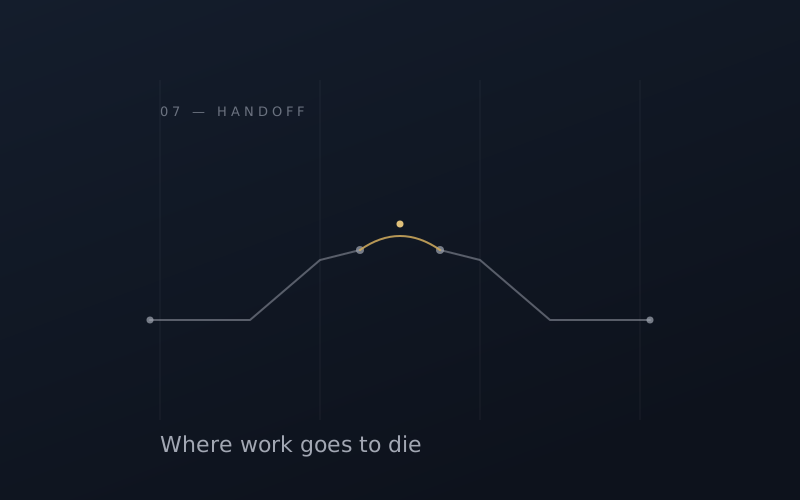
Map any slow process end to end and you find something uncomfortable. The teams are fast. The work inside each step moves. The delay lives in the spaces between them, in the queue where a task sits after one team is finished and before the next has noticed.
The gaps are invisible, so nobody owns them
A team optimizes what it can see, which is its own backlog. The moment work leaves your queue, it stops being your problem and is not yet anyone else's. So it waits. It waits for context that was never written down, for a question no one thought to ask, for an inbox that gets checked on Thursdays. Each team is locally efficient and the whole is globally slow.
This is why effort inside a function so often fails to speed up the end result. You can double a team's throughput and watch the customer notice nothing, because the bottleneck was never the work. It was the handoff.
A handoff is not a moment. It is a place. And places where no one stands get neglected.
Design the seam, not just the steps
Good operations treat the handoff as a deliverable in its own right. That means defining, explicitly, what a complete handoff contains: the inputs the receiving team needs, the form they need them in, and the trigger that says go. No telepathy, no "they will figure it out."
I find the cheapest improvement in most operations is not making any single step faster. It is removing a wait that nobody put there on purpose. Shorten the silences and the whole process tightens, often without a single team working harder.
So when something is slow, resist the urge to push the teams. Look at the seams between them first. The work rarely dies where it is being done. It dies where it is being passed.